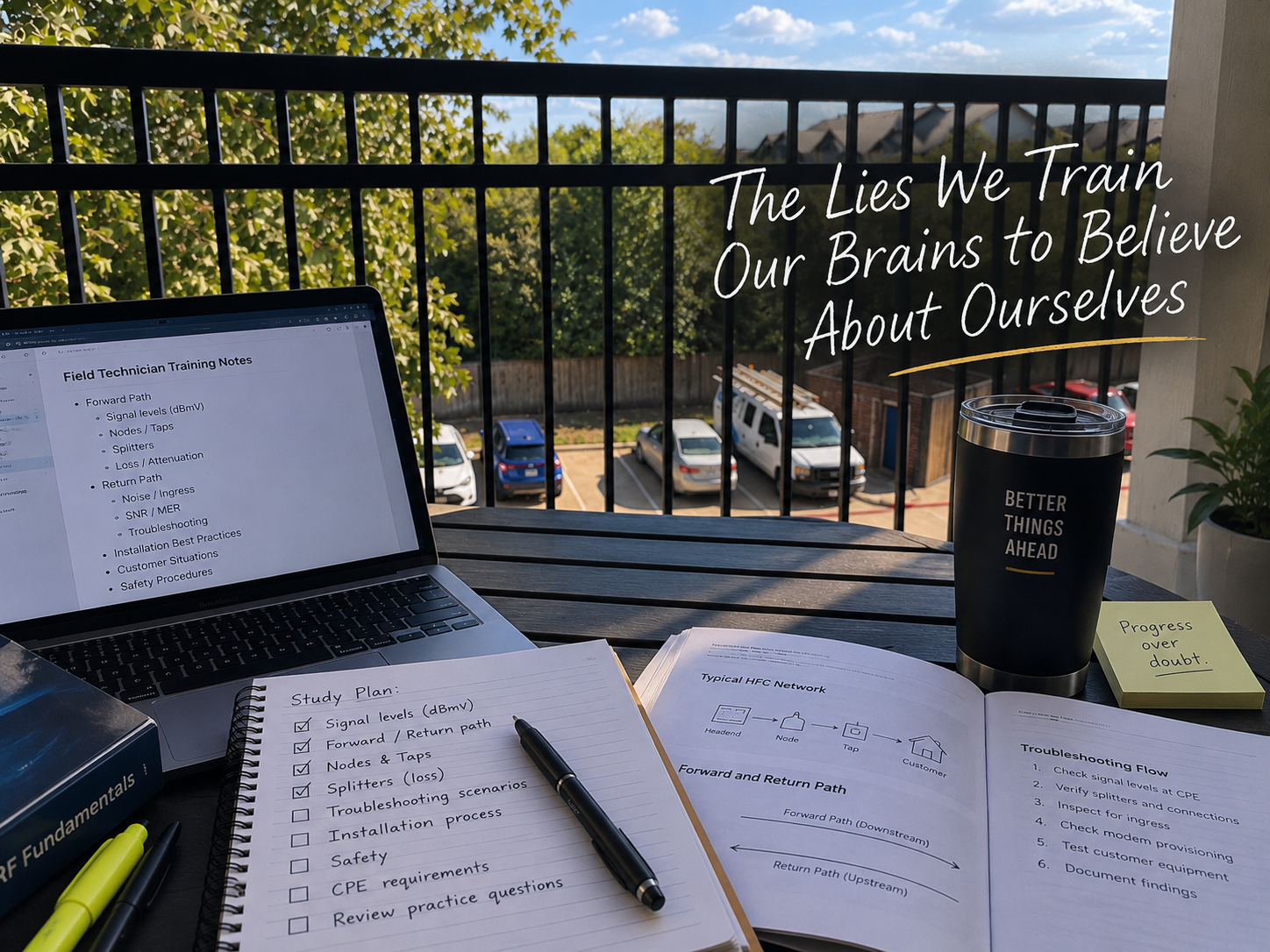
I got a 94% on a test that I had pretty much convinced myself I was going to fail.
Not just fail, either.
In my head, I had already played out the entire scenario.
I was going to fail the test. I wasn’t going to make it through training. I was going to lose my job. Everything I had worked for over the last few months was going to fall apart because I simply wasn’t smart enough to do this.
Then I took the test.
94%.
Second-highest score in the class.
And I remember thinking… how the hell did I convince myself that I couldn’t do this?
Because I didn’t suddenly become smarter when I sat down to take that test. I didn’t magically learn everything that morning.
I already knew it.
The problem was that I didn’t believe I knew it.
And I’ve been thinking about that a lot.
We Can Really Mess With Our Own Heads
The brain is a weird thing.
If you tell yourself something enough times, eventually you start believing it.
I’m not smart.
I’m bad at tests.
I can’t remember anything.
I’m going to screw this up.
Everyone else understands this better than I do.
I’m not going to make it.
Those weren’t just random thoughts I had before my test. I was starting to actually believe them.
During training, there were times when I would get a question wrong because I misunderstood what it was asking.
And instead of thinking, “Oh, I read that wrong,” my brain would immediately go to:
“See? You don’t know this.”
There were times when I knew the answer but second-guessed myself.
“See? You’re not ready.”
There were things I had to go over multiple times before they finally clicked.
“Everyone else gets this. Why can’t you?”
It didn’t matter how many questions I got right.
I’d remember the ones I got wrong.
It didn’t matter how much I had learned.
I’d focus on what I still didn’t understand.
And slowly I had built this entire case against myself.
The funny part?
Apparently, the evidence wasn’t very good.
Because I got a 94.
And Then I Started Thinking About the Rest of My Life
That’s when this became about more than a test.
How many times have I done this to myself before?
How many things have I decided about myself just because I thought them enough times?
Because I’ve definitely done it academically.
For a long time, I’ve had this idea in my head that maybe I’m just not that smart.
If something doesn’t click immediately, I get frustrated.
If I misunderstand a question, I feel stupid.
If someone else understands something faster than I do, I compare myself to them.
But maybe taking longer to understand something doesn’t mean you’re stupid.
Maybe it just means it took you longer to understand it.
That’s it.
Why do we have to turn everything into some huge statement about who we are?
“I got this question wrong” becomes “I’m stupid.”
“I made a mistake at work” becomes “I’m terrible at my job.”
“I screwed something up” becomes “I screw everything up.”
Someone hurts us and suddenly we’re unlovable.
Someone leaves and suddenly everyone is going to leave.
Something doesn’t work out and suddenly nothing ever works out for us.
We take moments and turn them into identities.
Work Is Another Big One
Starting a new career has been humbling.
There is a LOT to learn.
And there have absolutely been moments where I’ve wondered if I was cut out for it.
You watch someone who’s been doing the job for years and they make everything look easy.
Then you try it and you’re thinking about every single step.
And it’s really easy to look at that person and think, “I’m never going to be that good.”
But that’s ridiculous when you actually think about it.
Of course they’re better at it.
They’ve done it a thousand times.
I’m still learning.
But our brains don’t always make that distinction.
Instead of saying:
“I’m new at this.”
We say:
“I’m bad at this.”
Those are not the same thing.
And I think I’ve spent a lot of my life confusing the two.
We Do It Emotionally Too
This is probably where it gets even harder.
Because the things we tell ourselves emotionally aren’t as easy to disprove as a test score.
Nobody hands you a piece of paper that says:
Congratulations! You are officially good enough.
You are worthy of being loved.
You are not a burden.
You are doing better than you think.
So when you’ve spent years telling yourself something negative, it can become incredibly hard to separate the thought from reality.
“I’m too much.”
“I’m not good enough.”
“I always mess things up.”
“I’m difficult to love.”
“I should be further along in life by now.”
“I’ll probably fail anyway.”
At some point those stop sounding like fears.
They just start sounding like facts.
And that’s scary.
Because once you believe something about yourself, you start living around that belief.
You don’t apply for something because you assume you won’t get it.
You don’t speak up because you assume you’ll sound stupid.
You don’t try something because you’re afraid you’ll fail.
You don’t give yourself credit when you succeed because somehow your brain finds a way to explain that away too.
Then when something goes wrong?
“SEE! I knew it!”
Our brains can be assholes sometimes.
A 94 Didn’t Suddenly Make Me Smart
And I think that’s important.
I’m not writing this because I got a good test score and now suddenly I think I’m the smartest person in the room.
That’s not the point at all.
The 94 didn’t make me smart.
It showed me that my opinion of myself wasn’t matching reality.
I walked into that test as the exact same person who walked out of it.
Same brain.
Same knowledge.
Same weaknesses.
Same strengths.
The only difference was that afterward I had something sitting in front of me that made it really hard to keep saying, “You’re not smart enough.”
94%.
Second-highest score.
My brain had spent weeks telling me one story.
Reality told me another.
So What Else Is My Brain Wrong About?
That’s the question I keep coming back to.
What else have I decided about myself that isn’t actually true?
And I think that’s something all of us should probably ask ourselves every once in a while.
When you think:
“I’m not good enough.”
Okay.
Says who?
“I’m going to fail.”
Do you actually know that?
“I’m terrible at this.”
Or are you still learning?
“I’m weak.”
Or are you going through something difficult?
“I’m behind everyone else.”
According to what timeline?
“I’m not smart enough.”
Is that actually true?
Or did something make you feel stupid once and you’ve been carrying it around ever since?
There’s a big difference between what we feel and what is true.
That’s something I’m still trying to learn.
Because when I was preparing for that test, I didn’t feel capable.
I felt scared.
I felt overwhelmed.
I felt like I wasn’t retaining enough.
I felt like everyone else probably knew more than I did.
But feelings aren’t always facts.
I was scared I would fail.
I didn’t fail.
I thought I wasn’t smart enough.
I got a 94.
I thought I might lose my job because I couldn’t do it.
I was wrong.
And I’m actually really glad I was wrong.
Because now when my brain starts telling me that I’m not capable of something, I have a pretty good response.
“Yeah… you’ve been wrong before.”
Maybe that’s the bigger lesson I’m taking from all of this.
We spend so much time trying to become better versions of ourselves that sometimes we don’t realize we’re already better than the version we’ve created in our heads.
Maybe you’re more capable than you think.
Maybe you’re smarter than you give yourself credit for.
Maybe you’re stronger than the voice in your head says you are.
And maybe some of the things you’ve believed about yourself for years aren’t facts at all.
Maybe they’re just stories you’ve repeated so many times that you forgot you were the one telling them.
I’m trying to stop doing that.
I’m sure I’ll still doubt myself. I’m sure I’ll still overthink things. I’m sure there will be another situation eventually where I’ve already convinced myself I’m going to fail before I’ve even tried.
But hopefully I’ll remember this one.
I’ll remember sitting there absolutely convinced that I wasn’t smart enough.
And then I’ll remember the number.
Not because a test score determines my worth or intelligence.
But because sometimes you need a reminder that the voice inside your head doesn’t always know what the hell it’s talking about.